Topic Tree: Jottler's AI-Powered Content Strategy Engine
Most teams treat content strategy as a one-time planning project. Topic Tree turns it into a living system.
When you connect your site, Jottler analyzes your business, market, and current content, then generates a structured taxonomy of strategic SEO pillars and subtopics. This becomes the engine behind what gets created, scheduled, and published.
Topic Tree is not a random idea list. It is your content operating model.
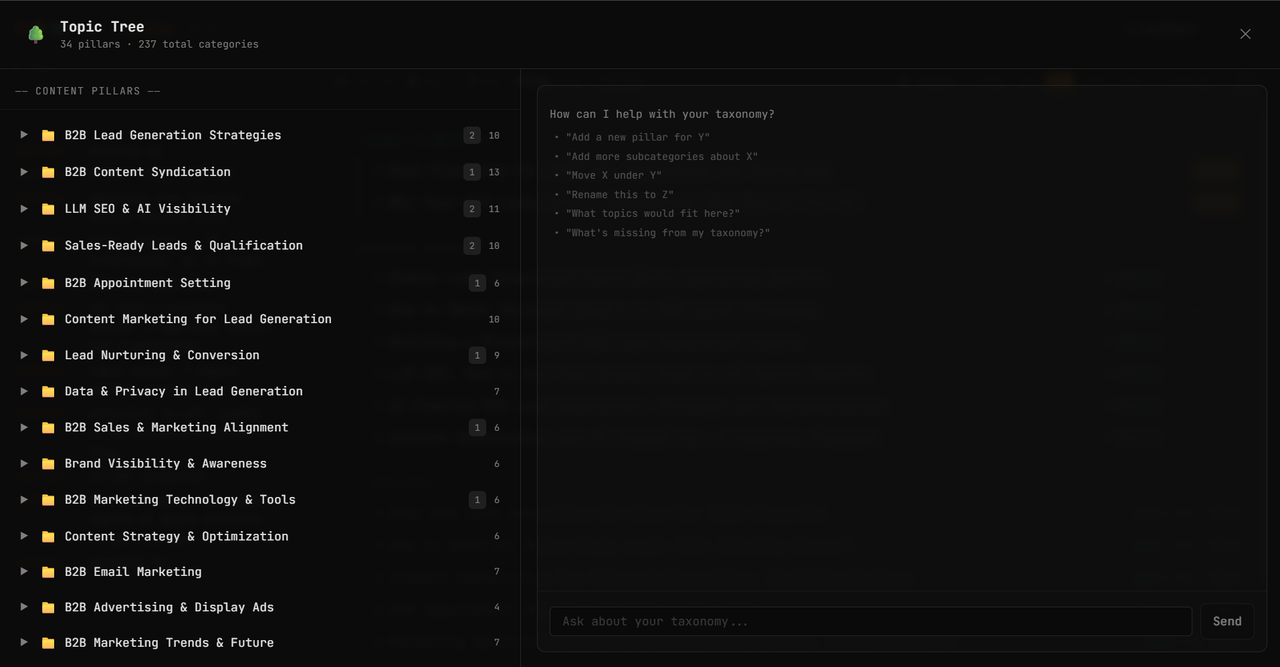
Topic Tree in the Jottler dashboard: pillar structure, expansion, and strategic coverage at a glance.
Why Topic Tree matters
Search performance is driven by topical authority, not isolated articles. Publishing one post on a theme is weak. Publishing connected coverage across a pillar builds trust with search engines and users.
Topic Tree helps you:
- Build depth across core SEO pillars
- Keep coverage balanced across the buyer journey
- Prioritize topics with ranking and business potential
- Turn strategy directly into execution through Jottler's writing pipeline
How Jottler builds your Topic Tree
1. Full site discovery
Jottler maps your domain and analyzes key pages such as product, feature, pricing, use case, and existing content pages. This gives the system business and context awareness before generating strategy.
2. Brand and market synthesis
From your site and settings, Jottler infers:
- What you sell and how you position it
- Who your audience is and what they care about
- Which questions and pain points drive search demand
- Where your current content has depth vs gaps
3. Taxonomy generation
Jottler creates a hierarchical structure of pillars and subcategories. Each pillar is designed to support search intent coverage and reinforce your domain authority over time.
Selection is influenced by:
- Relevance to your product and audience
- Search opportunity
- Coverage gaps
- E-E-A-T fit (Experience, Expertise, Authoritativeness, Trustworthiness)
From strategy to execution
Topic Tree feeds the rest of the Jottler system automatically:
- Topic generation: ideas are pulled from across pillars, not one narrow theme
- Scheduling: topics are distributed into your publishing cadence
- Prioritization: queue order reflects strategic value and coverage needs
- Replenishment: as items publish, new topics are generated to keep flow steady
- Replace behavior: declined items are replaced while preserving pillar balance
This keeps the pipeline healthy while maintaining strategic coherence.
Managing Topic Tree
Open Topic Tree from your dashboard Topics area to view your pillar structure. You can modify it at any time using natural language in the built-in AI editor.
Examples:
- Add a new pillar for an emerging theme
- Expand a pillar with deeper subtopics
- Move a subtopic under a better parent pillar
- Remove a pillar that is no longer relevant
- Ask for coverage gaps by pillar
If your business shifts, regenerate the tree and Jottler will rebuild strategy from your latest site and settings.
Built for E-E-A-T
Topic Tree is designed to support strong E-E-A-T signals:
- Experience: grounded in your actual business and use cases
- Expertise: deep cluster coverage instead of shallow topic scatter
- Authoritativeness: interconnected pillar structure strengthens internal authority
- Trustworthiness: content pipeline emphasizes factual, useful, user-focused outputs
What makes it different
Compared with spreadsheet-driven planning, Topic Tree gives you:
- Strategy generated in minutes, not weeks
- A living taxonomy you can evolve anytime
- Personalized pillars based on your business context
- Direct connection between planning and publishing
Bottom line
Topic Tree removes strategy bottlenecks and makes content execution compounding. You provide business context. Jottler builds and evolves the content architecture, then uses it to continuously produce and publish strategically aligned articles.